Picture Gallery
The polar bear (Ursus maritimus) is a bear native largely within the Arctic circle encompassing the Arctic Ocean, its surrounding seas and surrounding land masses. It is the world's largest land carnivore and also the largest bear, together with the omnivorous Kodiak bear, which is approximately the same size.[3] An adult male weighs around 350–680 kg (770–1,500 lb),[4] while an adult female is about half that size. Although it is closely related to the brown bear, it has evolved to occupy a narrow ecological niche, with many body characteristics adapted for cold temperatures, for moving across snow, ice, and open water, and for hunting the seals which make up most of its diet.[5] Although most polar bears are born on land, they spend most of their time at sea (hence their scientific name meaning "maritime bear") and can hunt consistently only from sea ice, so spend much of the year on the frozen sea. | 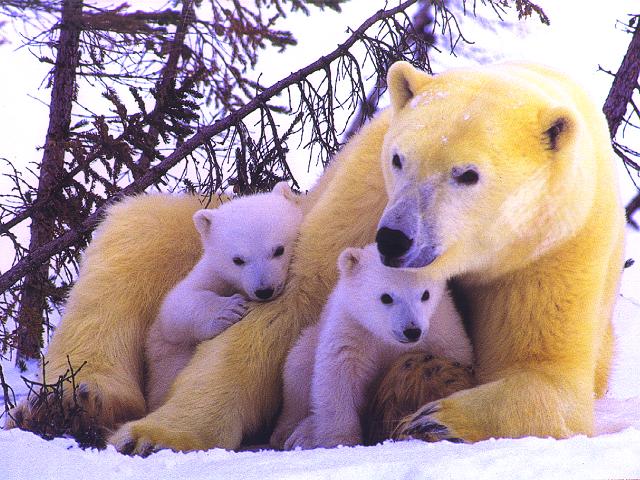 |
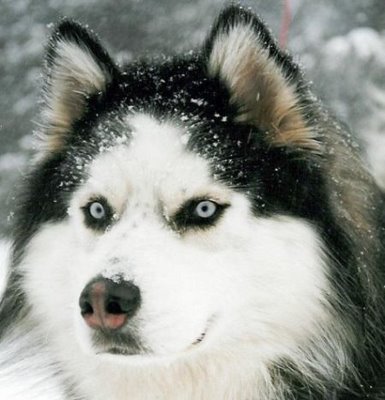
The Siberian Husky (Russian: Сибирский хаски, Sibirskiy haski, "Siberian husky") is a medium-size, wolf-like, dense-coat working dog breed that originated in eastern Siberia. The breed belongs to the Spitz genetic family. It is recognisable by its thickly furred double coat, sickle tail, erect triangular ears, and distinctive markings. Huskies are an active, energetic, and resilient breed whose ancestors came from the extremely cold and harsh environment of the Siberian Arctic. Siberian Huskies were bred by the Chukchi of Northeastern Asia to pull heavy loads long distances through difficult conditions. The dogs were imported into Alaska during the Nome Gold Rush and later spread into the United States and Canada. They were initially sent to Alaska and Canada as sled dogs but rapidly acquired the status of family pets and show dogs 
|  |
